
Lance Thrailkill on How to Revolutionize Housing with 3D Printed Construction
Lance Thrailkill has built a career on blending tradition with technology. As the third-generation leader of All Metals Fabricating, he honors the legacy of American manufacturing. But through his work as co-founder of PRINT3D Technologies, he is channeling that experience toward a new frontier: solving the housing crisis through 3D printed construction.
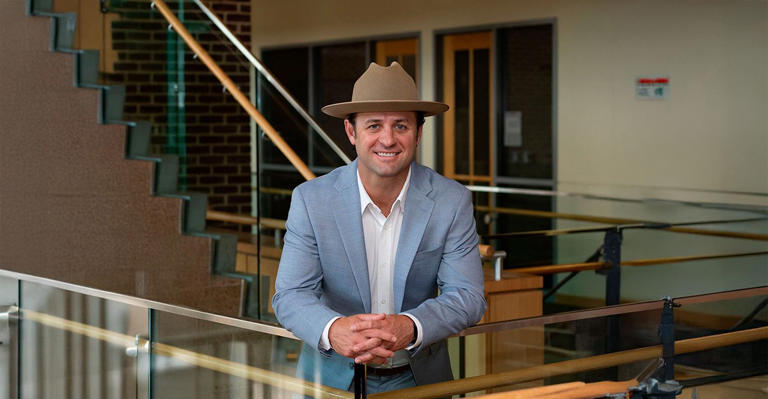
“I saw this huge void in the construction industry,” says Thrailkill. “It is the most inefficient, antiquated industry out there.” With a background in operational leadership, automation, and hands-on manufacturing, he recognized an opportunity to bring efficiency and scalability to a sector long overdue for transformation.
From Manufacturing Excellence to Construction Innovation
All Metals Fabricating is known for its commitment to continuous improvement, precision, and lean manufacturing principles. Under Thrailkill’s leadership, the company is on a path to become the most automated job shop in the world by 2031. That automation-first mindset is what led him to see potential in the construction space. “I was just totally shocked by the lack of efficiency in the construction industry,” says Thrailkill. “It is the most inefficient, antiquated industry out there. What industry is still doing things the same way they did 100 years ago?”
His exposure to residential construction through his business partner Craig Pettit laid the groundwork for a new venture. When Pettit successfully printed two 3D homes for a rental portfolio, Thrailkill was intrigued. The technology offered a faster, cheaper, and more precise approach to building. They soon launched PRINT3D Technologies, combining Thrailkill’s manufacturing background with Pettit’s real estate and construction experience to address the affordable housing crisis with modern tools.
Why 3D Printed Homes are Different
According to Thrailkill, the advantages of 3D printed homes go far beyond speed and cost. “These houses are mold resistant, termite resistant, fire resistant, hurricane and tornado resistant,” he says. “They are stronger, more durable, and have better thermal performance.” Because the printing process replaces traditional framing and drywall, the structure requires fewer trades to complete. “You’re removing framing, sheetrock, painting, and insulation. That’s up to five trades. You still get a superior product with fewer moving parts.” The time savings are significant. Wall systems that would traditionally take weeks or months to complete can now be printed in one to two weeks during standard eight-hour shifts. With 24-hour operation, timelines shrink even further. On cost, Thrailkill estimates a savings of around 20 percent on the wall systems alone, with long-term potential to reduce total build costs by up to 40 percent.
Addressing Labor and Supply Shortages
The U.S. housing market is in critical condition. With an estimated 7.4 million affordable homes needed and only 1.4 million built annually, the gap continues to widen. Thrailkill believes 3D printing is one of the few tools capable of scaling production while maintaining quality. “Right now, the industry’s solution is to throw more people at the problem and use cheaper materials,” he says. “That leads to lower quality. With 3D printing, you need only one or two operators per machine. You can print multiple homes at the same time without sacrificing craftsmanship.” PRINT3D’s equipment, developed in-house through All Metals Fabricating, is built with a focus on precision and reliability. The technology eliminates much of the skilled labor currently in short supply while offering a construction method that is faster and more scalable than anything in the current market.
Overcoming Regulatory and Cultural Barriers
Despite the clear benefits, one of the biggest challenges for 3D printed construction is municipal approval. “Municipalities don’t know how to inspect the plans, much less the print quality,” Thrailkill explains. “They are hesitant to take risks with unfamiliar technology.” Some cities have begun to adapt. Austin and areas in Colorado and California have taken early steps toward embracing 3D printing in residential zoning. Industry standards are also in development, which Thrailkill hopes will lead to broader regulatory acceptance. Consumer perceptions are another barrier. Many homeowners still associate 3D printed homes with the distinctive layered “bead” appearance, but this is changing. “We’re developing new print heads that create a brick-style finish or smooth walls,” says Thrailkill. “We can already do smooth walls manually. Soon we’ll automate that too.”
A Scalable Vision for the Future
Looking ahead, Thrailkill envisions a future where construction sites are operated by a few technicians managing fleets of printers from tablets. “Our machines are virtually silent. That means you could print homes at night in residential areas without noise concerns. Imagine being able to print a house in a day or two.” His focus is not on flashy promises, but on practical, scalable change. He points to the convergence of AI, robotics, and new materials as factors that will only accelerate progress. While 3D printed construction is still in its early stages, the long-term potential is clear. “This technology solves both sides of the equation,” he says. “It addresses the skilled labor shortage and speeds up the supply of homes. And it does it with a product that’s better, not worse.”
For Lance, this is more than a business opportunity. It is a mission to solve a national challenge using tools rooted in precision, efficiency, and innovation. To follow Lance Thrailkill’s work, connect with him on LinkedIn or visit his website.